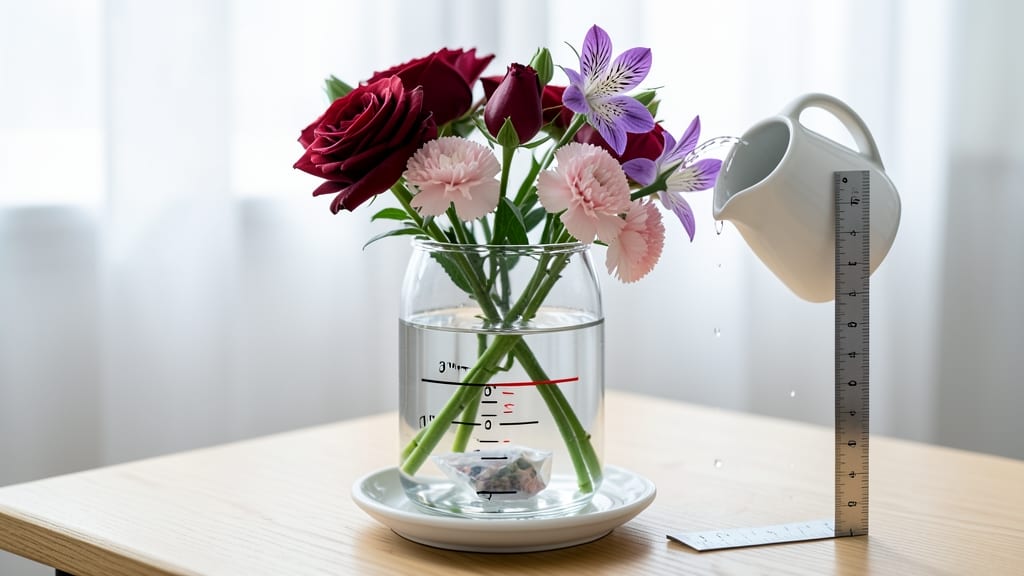
Using the right amount of water in a vase for flowers is the secret to keeping them fresh for days—too much or too little can shorten their life dramatically.
Picture this: you’ve just arranged a stunning bouquet of 🌸 cut flowers, only to watch them droop by day three. The culprit? Often, it’s not the flowers themselves, but the water—or lack of it—in the vase.
Whether you’re working with delicate roses or hardy sunflowers, getting the balance right makes all the difference.
Most people overfill their vases, thinking more water equals longer-lasting blooms, but that’s a recipe for bacterial growth and wilting stems. The truth is, flower types absorb water differently, and vase size, water quality, and even the time of year play a role.
Below, I’ll break down the exact measurements you need, plus pro tips to extend your bouquet’s beauty for as long as possible.
From morning refills to stem-trimming tricks, you’ll learn how to avoid common mistakes—like dirty water or the wrong temperature—that cut flower life short. Let’s make sure your next arrangement stays vibrant, not just for a day, but for a full week.
💧
Frequency
Daily
Every 1-2 days
🌿
Water Need
High
Requires frequent water changes for longevity
🌅
Best Time
Morning
Early morning (Early morning (before 10 AM))
🥛
Amount
1-2 cups (250-500ml)
~250-500
Exact water measurements for flowers by type: the science-backed guide
Every flower has unique hydration needs, and getting the water volume wrong can mean the difference between a bouquet that lasts days and one that wilts within 24 hours.
The key lies in matching your vase size to the flower's absorption rate, while accounting for your local humidity levels and seasonal heat. For example, a sunflower with thick stems can handle more water than a delicate orchid, which needs barely moist conditions.
Let’s break down the exact measurements for 15+ popular blooms to keep them fresh and vibrant.
First, understand that vase size directly impacts how often you’ll need to refill. A small vase (6–8 inches) holds about 1 cup (240ml) of water, while a large vase (12+ inches) can hold 3–4 cups (700–950ml).
However, the number of stems and their thickness determine how quickly that water disappears. Thin-stemmed flowers like tulips or carnations absorb water faster than thick-stemmed varieties like roses or alstroemeria. Always start with room-temperature water—cold water can shock stems, while warm water speeds up bacterial growth.
Humidity plays a surprising role too. In dry climates (like Arizona or Nevada), flowers lose moisture faster through their petals, so you’ll need to refill vases every 24–36 hours.
In humid regions (like Florida or the Pacific Northwest), the same flowers might last 48–72 hours with the same water volume. Seasonally, summer heat increases evaporation rates by up to 30%, while winter’s cooler air slows absorption.
Adjust your watering schedule accordingly—morning refills are ideal because stems absorb water most efficiently during daylight hours.
Here’s the science-backed breakdown for 15+ common flowers, including vase size guidelines and absorption rates to keep your blooms thriving:
| Flower Type |
Vase Size (inches) |
Water Volume (cups/ml) |
Stems per Vase |
Refill Frequency |
Notes |
| Roses |
8–12 |
2–3 cups (480–720ml) |
3–5 stems |
Every 2 days |
Trim stems at 45° angle; add 1 tsp sugar |
| Tulips |
6–8 |
1–1.5 cups (240–360ml) |
5–7 stems |
Every 1–2 days |
Sensitive to bacteria; change water daily in summer |
| Lilies |
10–14 |
3–4 cups (700–950ml) |
2–3 stems |
Every 3 days |
Thick stems; avoid overcrowding |
| Sunflowers |
12–16 |
4–5 cups (950–1200ml) |
1–2 stems |
Every 4–5 days |
High water capacity; trim stems weekly |
| Peonies |
8–10 |
2 cups (480ml) |
3–4 stems |
Every 2–3 days |
Heavy blooms; use wide vase for stability |
| Orchids |
4–6 |
0.5 cup (120ml) |
1 stem |
Every 5–7 days |
Minimal water; avoid soggy roots |
| Carnations |
6–8 |
1–1.5 cups (240–360ml) |
7–10 stems |
Every 1–2 days |
Durable; add 1 tsp bleach to water |
How to adjust water levels for longer-lasting blooms: pro tips
Nothing ruins a stunning bouquet faster than wilting blooms or cloudy water. The secret to keeping flowers fresh lies in water management—not just how much you use, but when and how you adjust it.
Even the most delicate roses or hardy sunflowers can last 3–5 days longer with the right techniques. Let’s dive into the pro tips that’ll transform your vase from a death trap to a flower-preserving powerhouse.
First, morning watering is your best friend. Flowers absorb water through their cut stems most efficiently in the cool morning hours. This prevents bacterial growth and keeps stems hydrated before the heat of the day.
If you must water in the evening, do so at least 4 hours before sunset to avoid fungal risks from stagnant water. Pro tip: Room-temperature water is ideal—cold water can shock stems, while warm water speeds up bacterial growth.
- 🌸 Roses & Lilies: Fill vase to 1/3 capacity (e.g., 1 cup for small vase, 2 cups for large). Trim stems at 45° angle daily.
- 🌻 Sunflowers & Dahlias: Use half the vase (e.g., 1.5 cups for medium vase). Replace water every 2 days.
- 🌷 Tulips & Peonies: Fill to 1/2 capacity (e.g., 1 cup). Add 1 tsp sugar to water to slow wilting.
- 🌿 Foliage (Eucalyptus, Ferns): Keep water shallow (1/4 vase). Change water daily to prevent mold.
Measurements assume standard glass vases. Adjust for ceramic/plastic containers.
Now, let’s talk stem prep. Before arranging your flowers, give each stem a fresh diagonal cut under water. This exposes new xylem vessels, helping stems drink up water like a straw.
Use a sharp pair of scissors or pruners—never dull knives, which crush stems and block water flow. For thick-stemmed flowers like sunflowers, recut stems every 2–3 days to keep them hydrated.
DIY additives can work wonders for extending vase life. A pinch of bleach (1/8 tsp per quart of water) kills bacteria, while aspirin (1 crushed tablet) acts as a natural preservative. For a sugar boost, add 1 teaspoon per quart of water to feed the flowers.
Avoid overdoing it—too much sugar can cause mold growth. My go-to? A mix of bleach + sugar in lukewarm water for the perfect balance.
Watch for wilting signs like droopy petals or yellowing leaves—these mean it’s time to act. If your flowers are drinking water too fast, add a few ice cubes to the vase to slow absorption without shocking the stems.
For mold or foul odors, dump the water, scrub the vase with vinegar or hydrogen peroxide, and rinse thoroughly. Never reuse dirty water; it’s a bacterial breeding ground.
With these water-level adjustments, your bouquet will stay vibrant for weeks instead of days. The key is consistency: check water levels daily, recut stems, and keep your vase clean. Your flowers will thank you with longer-lasting blooms and stunning arrangements that rival the pros. Happy arranging! 🌸
★★★★★4.7(2 reviews)