
Container Gardens
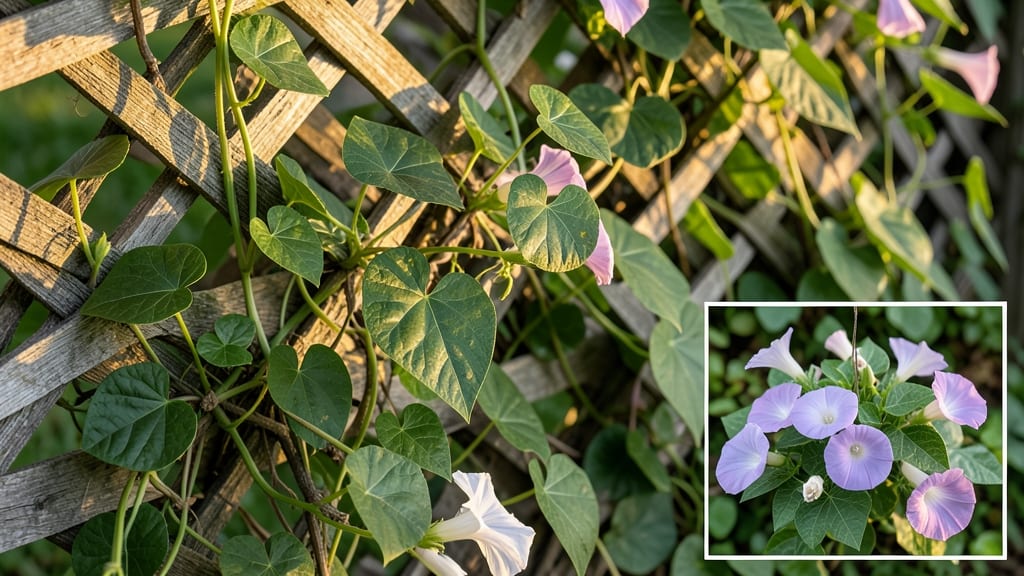
Bindweed and morning glory are not the same plant, though both are aggressive vines: bindweed (Convolvulus arvensis) features heart-shaped leaves and deep underground rhizomes, while morning glory (Ipomoea spp.) has trumpet-shaped flowers and thinner stems. Their growth patterns and root structures set them apart completely.
While both plants share the "vine" classification, their botanical differences are striking. Bindweed's deep rhizomes can spread up to 20 feet underground, making it nearly impossible to eradicate once established.
Morning glory, on the other hand, has shallow roots and annual growth habits, dying back each winter. 🌱 The leaf arrangement also differs—bindweed leaves grow alternately along the stem, while morning glory's leaves are more evenly spaced. These distinctions matter when choosing garden companions or managing invasive species.
Gardeners often confuse the two because both climb aggressively, but their flower structures are the easiest way to tell them apart. Bindweed produces white to pink funnel-shaped blooms that appear in clusters, while morning glory's trumpet-shaped flowers come in vibrant colors like blue, purple, or yellow.
This visual difference is crucial for proper identification and control strategies.
💡 In This Article
- Botanical Differences Between Bindweed and Morning Glory
- Identifying Bindweed vs Morning Glory in Gardens
Botanical differences between bindweed and morning glory
The most fundamental distinction lies in their botanical families: bindweed (Convolvulus arvensis) belongs to the Convolvulaceae family, while morning glory (Ipomoea spp.) is also in Convolvulaceae but represents a different genus.
This classification matters because it explains why bindweed develops thick, woody rhizomes that can extend 15-20 feet underground, while morning glory produces fibrous roots that rarely exceed 1-2 feet in depth. 🌱 These root systems directly impact their invasiveness—bindweed's rhizomes allow it to regenerate from tiny fragments, whereas morning glory relies on annual seed production for spread.
The leaf structure provides another clear visual marker: bindweed leaves are heart-shaped (cordate) with pointed tips and grow alternately along the stem, creating a zigzag pattern. Morning glory leaves, however, are more oval or arrowhead-shaped with smooth edges and grow in a more symmetrical spiral pattern.
When crushed, bindweed leaves release a faint musty odor, while morning glory leaves have a milder, almost sweet scent—this sensory difference can help with field identification. The vein patterns also differ: bindweed leaves have prominent veins that create a web-like structure, while morning glory leaves feature more parallel venation.
Flower morphology offers the most reliable identification method. Bindweed produces 5-petaled, funnel-shaped flowers that are typically 1-1.5 inches wide, ranging from white to pale pink. These blooms appear in clusters at stem junctions and often have twisted petals that give them a slightly distorted look.
Morning glory flowers, in contrast, are trumpet-shaped with 5 fused petals, measuring 2-4 inches long, and come in vibrant colors like blue, purple, or yellow.
The flower structure affects pollination—bindweed attracts bees with its nectar, while morning glory relies on hummingbirds and butterflies due to its deeper throat. 🌸
Growth habits further separate these vines: bindweed is a perennial that grows aggressively throughout the season, while morning glory is typically an annual that completes its life cycle in one growing season.
Bindweed's stems can reach 10-15 feet in length, while morning glory vines usually max out at 6-10 feet. The climbing mechanism differs too—bindweed uses twining stems that wrap clockwise, while morning glory employs petiole tendrils that grasp surfaces more loosely.
These growth differences influence how they spread in gardens and landscapes.
Ecologically, bindweed's deep rhizomes allow it to outcompete native plants by accessing water and nutrients from greater soil depths. Morning glory, while still invasive, primarily spreads through seeds that can remain viable in the soil for 5-10 years. This seed bank strategy contrasts with bindweed's vegetative reproduction method.
Understanding these ecological differences helps gardeners choose appropriate control methods—mechanical removal works for morning glory seeds, while bindweed requires targeted rhizome excavation or herbicide application to 2-3 inches below soil level to prevent regrowth. 🌿
One often-overlooked detail is the seed pod structure: bindweed produces round, capsule-like seed pods that split open when mature, while morning glory develops spiral seed capsules that twist as they dry. These pods contain 2-4 seeds for bindweed versus 1-2 seeds for morning glory, further illustrating their reproductive strategies.
The timing of seed production also differs—bindweed seeds mature late summer to fall, while morning glory seeds ripen mid to late summer. 🌱