
Companion Plants
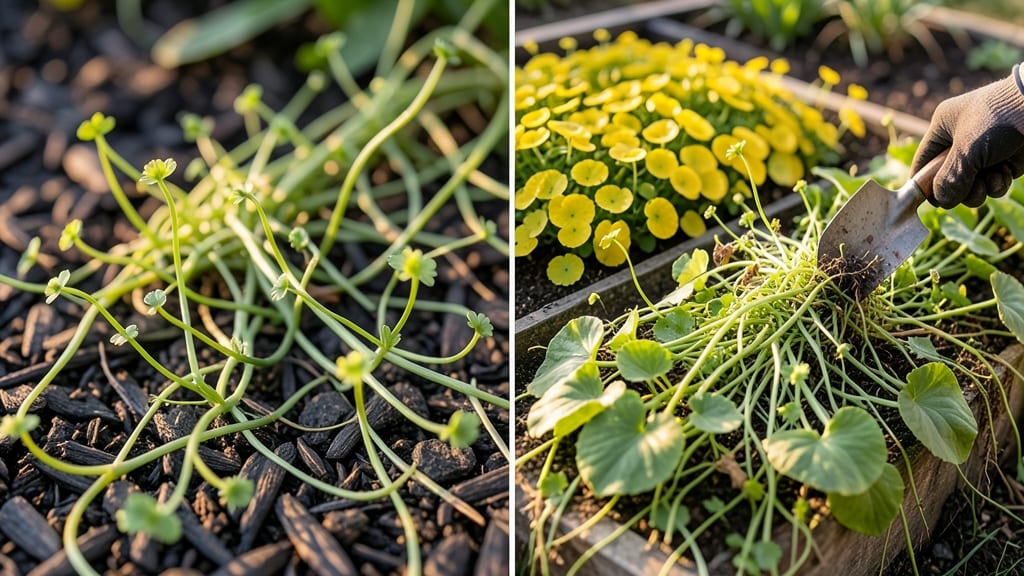
Creeping Jenny isn't a weed—it's a cultivated ground cover with ornamental value, though its rapid spreading habit can make it behave like one if left unmanaged. This hardy perennial (Lysimachia nummularia) thrives in gardens precisely because of its vigorous growth.
Creeping Jenny earns its reputation as a "weedy" plant from its horizontal stems that root at every node, creating dense mats up to 2 feet wide. 🌿 Unlike true weeds, however, it's not invasive in the ecological sense—it doesn't displace native species or spread uncontrollably in wild areas.
Gardeners actually prize it for erosion control and filling bare spots between stepping stones. The key difference lies in intent: while weeds are unwanted, Creeping Jenny is a designer ground cover when properly contained with edging or containers.
Its golden foliage and adaptability to partial shade make it a favorite in landscaping, but its spread requires planning. I've seen it transform rocky slopes into lush green carpets while also choking out delicate perennials if given free rein.
The solution? Use it strategically in areas where its vigor is an asset, not a liability.
💡 In This Article
- Botanical Classification and Growth Habits of Creeping Jenny
- Managing Creeping Jenny in Gardens: Control and Design Tips
Botanical classification and growth habits of Creeping Jenny
Creeping Jenny belongs to the Primulaceae family, specifically the Lysimachia genus, which includes over 200 species of perennials and shrubs. Unlike true weeds that often belong to aggressive families like Poaceae (grasses) or Asteraceae (dandelions), Creeping Jenny's botanical classification places it among ornamental plants.
Its scientific name, Lysimachia nummularia, comes from the Greek "lysimachia" meaning "to cure," referencing its historical medicinal uses rather than its gardening reputation. 🌱
The plant's growth mechanism sets it apart from weeds: it spreads via stolons (horizontal stems) that root at every node, creating a dense mat up to 2 feet wide annually. This differs from weed propagation, which often relies on seeds or underground rhizomes that spread uncontrollably.
Creeping Jenny's native habitat in Europe and Asia explains its adaptability to temperate climates, where it thrives in USDA zones 4-9 without requiring special care. Its leaves contain 0.5-1% essential oils, contributing to its hardy, glossy appearance.
What makes Creeping Jenny valuable in gardens is its non-invasive ecological behavior. Unlike aggressive weeds that disrupt ecosystems, it doesn't spread into wild areas or outcompete native plants. Its shallow root system actually helps suppress weeds by blocking sunlight, while its dense growth prevents erosion on slopes.
The confusion arises because its rapid spread mimics weeds—but unlike weeds, it's cultivated for ornamental purposes, with varieties like 'Aurea' offering golden foliage and 'Marginata' featuring cream-edged leaves.
Botanists distinguish Creeping Jenny from weeds through its controlled reproductive methods. It produces few seeds and relies on stolons for propagation, which gardeners can easily manage. True weeds, however, often produce thousands of seeds annually, ensuring widespread, uncontrollable growth.
Creeping Jenny's growth habit is more aligned with ground covers like pachysandra or ajuga, which are intentionally used for their spreading abilities in designed landscapes. 🌿
The plant's leaf structure also differs from weeds: its oval, 1-inch-long leaves have a smooth texture and vibrant green color, unlike the coarse, jagged leaves of many weeds. Its stems remain non-woody and flexible, allowing it to conform to garden contours without becoming invasive.
This adaptability makes it ideal for rock gardens, borders, and container plantings, where its spread can be contained through strategic placement.
Consider these key botanical differences:
- Propagation: Creeping Jenny spreads via stolons (controlled), weeds via seeds/rhizomes (uncontrolled)
- Ecological Impact: Non-invasive (suppresses other weeds), weeds disrupt ecosystems
- Cultivation Intent: Ornamental ground cover, weeds are unwanted intruders
- Leaf Structure: Smooth, glossy leaves (1 inch), weeds often have coarse, jagged foliage
Understanding these distinctions helps gardeners appreciate Creeping Jenny's role as a designer plant rather than a nuisance. Its growth habits, when managed properly, create stunning visual effects while serving functional purposes like erosion control. ✨