
Plants
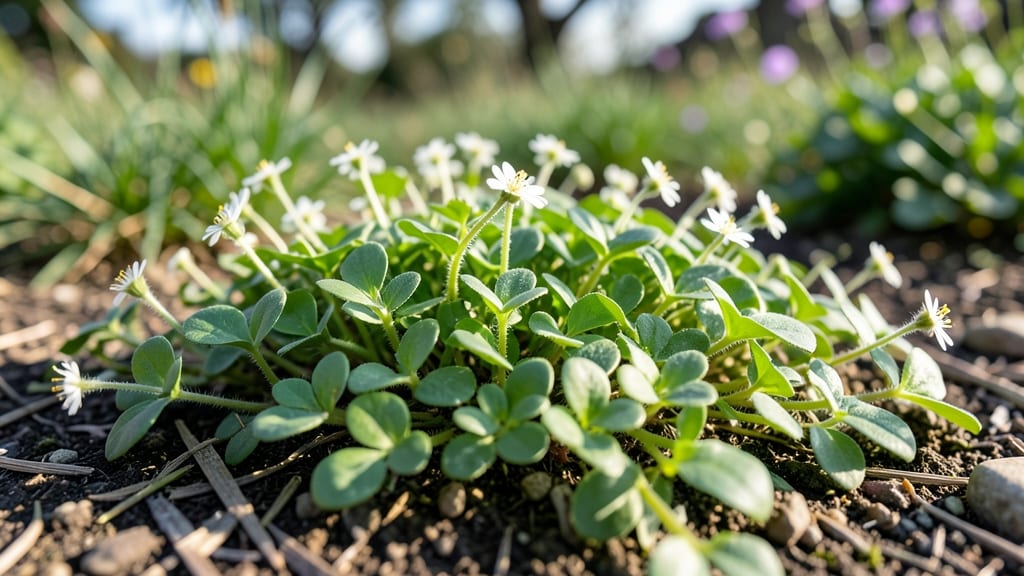
Common chickweed looks like a sprawling ground cover with tiny oval leaves that have smooth, slightly glossy surfaces, supported by weak stems that spread across the soil. The plant produces clusters of small white flowers and gives off a faint fresh scent when disturbed.
This delicate plant thrives in shady, moist areas and often appears in gardens or lawns as a low-growing weed. 🌱 The leaves are typically 1/2 to 1 inch long, arranged in opposite pairs along the stem, and can appear slightly succulent.
One key identifier is how the stems root at the nodes, allowing the plant to spread rapidly. Chickweed's flowers, though small, are distinctive with their five delicate petals and green-tipped stamens, making it easier to distinguish from similar-looking weeds.
The plant's growth habit changes with seasons—juvenile plants have more compact leaves, while mature specimens develop longer stems and more abundant flowering. This adaptability helps it survive in various conditions, from disturbed soil to shaded garden beds.
💡 In This Article
- Identifying Chickweed by Leaf, Stem, and Flower Structure
- How to Spot Chickweed in Gardens and Lawns
Identifying chickweed by leaf, stem, and flower structure
Common chickweed's leaves are its most defining feature, measuring roughly ½ to 1 inch long and ¼ to ½ inch wide, with a distinctive oval shape that tapers slightly at the base.
Unlike many plants, these leaves have smooth, slightly serrated edges (though the serrations are subtle) and a succulent texture that feels slightly plump and juicy to the touch.
The surface has a faint, almost translucent sheen when sunlight hits it at certain angles, giving it that "glossy" appearance mentioned in the quick answer.
The stems are where chickweed reveals its unique growth strategy. They're typically hairless or sparsely covered in fine hairs, ranging from 4 to 12 inches long as they sprawl across the ground.
What's fascinating is how these stems root at the nodes (the points where leaves attach), creating a network of new growth points. This characteristic, called prostrate growth, allows chickweed to spread rapidly in gardens, often forming dense mats.
The stems also have a delicate, almost thread-like appearance, which helps distinguish it from more robust weeds like creeping Charlie.
When it comes to flowers, chickweed's 5-petaled white blooms (about ¼ inch wide) are its most recognizable feature. Each flower has 10 stamens with green-tipped anthers, creating a subtle contrast against the white petals.
These flowers grow in loose clusters at the stem tips, often appearing in spring but continuing sporadically through summer. The scent you notice when crushing the plant comes from volatile organic compounds released when the leaf cells rupture, giving off that fresh, slightly cucumber-like aroma that's unique to chickweed.
Here's where chickweed differs from its lookalike, mouse-ear chickweed: the leaves of mouse-ear have a distinctive fuzzy texture and a more rounded shape, while common chickweed's leaves are smoother and more oval. Also, mouse-ear's stems are more upright, whereas common chickweed's stems stay close to the ground.
The flower clusters also differ—mouse-ear's are more compact and dense, while common chickweed's are more open and airy.
The plant's growth pattern changes dramatically with maturity. Young chickweed plants have smaller, more compact leaves arranged closely together, while mature plants develop longer internodes (spaces between leaves) and more extensive rooting at the nodes.
This seasonal variation helps it adapt to different conditions, from early spring growth to late summer persistence. The succulent leaves also contain about 90% water, which makes them particularly tender and sensitive to environmental changes.
One surprising detail is how chickweed's leaves can fold inward during dry periods to conserve moisture, then unfurl when conditions improve. This adaptation explains why it thrives in both moist and slightly drier conditions—it's remarkably resilient.
The combination of these structural features makes common chickweed instantly recognizable to those who know what to look for in the field. 🌿