
Size
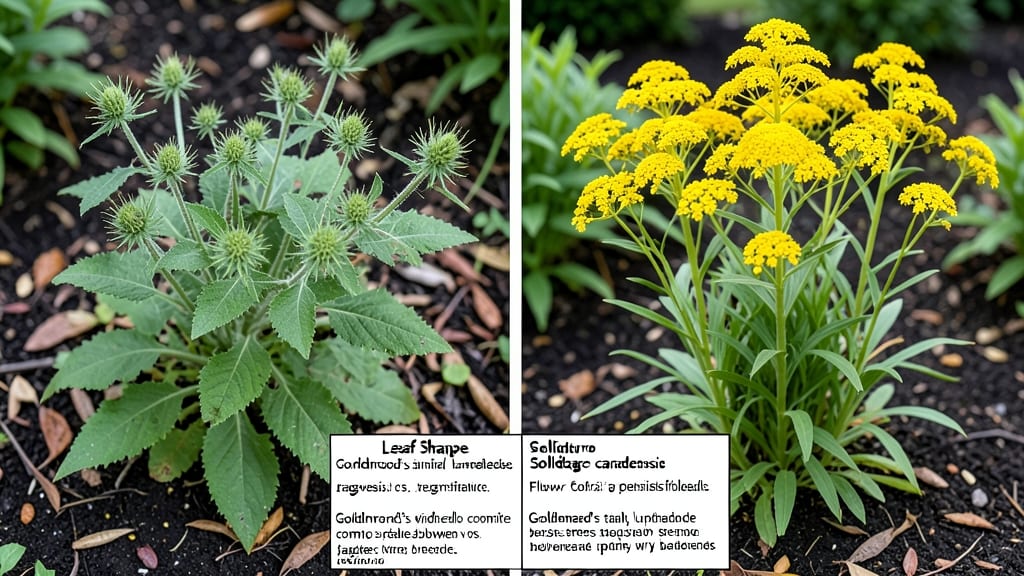
Goldenrod and ragweed are not the same plant: goldenrod features bright yellow flowers that attract bees and butterflies, while ragweed produces greenish blooms that spread pollen causing seasonal allergies. Their growth patterns and ecological roles differ entirely.
Many people confuse these plants because they bloom around the same time, but their characteristics couldn't be more different. 🌼 Goldenrod thrives in gardens with its vibrant yellow plumes and requires pollinators like bees, while ragweed spreads aggressively with wind-dispersed pollen that triggers allergies.
The misconception likely stems from goldenrod's late-summer blooming period coinciding with ragweed's peak pollen production.
What's interesting is how their growth habits reveal their true nature: goldenrod grows upright in clumps, while ragweed sprawls low to the ground. This structural difference explains why goldenrod rarely causes allergic reactions—its pollen is heavy and sticky, perfect for bees but not for traveling through the air.
💡 In This Article
- Botanical Differences Between Goldenrod and Ragweed
- Allergy Myths: Why Goldenrod Gets Blamed for Ragweed Pollen
Botanical differences between goldenrod and ragweed
Goldenrod (Solidago spp.) and ragweed (Ambrosia spp.) belong to entirely different plant families, with goldenrod in the Asteraceae family and ragweed in the Asteraceae family's subfamily Ambrosioideae. 🌼 The most striking difference lies in their flower structures: goldenrod produces dense, bright yellow plumes composed of tiny individual flowers (florets) that form composite heads, while ragweed's flowers are small, greenish, and less conspicuous, arranged in clusters.
Goldenrod's flowers are packed with nectar and pollen designed specifically for insect pollinators like bees, butterflies, and beetles.
Pollen production and dispersal methods reveal their ecological roles. Goldenrod produces pollen that's heavy and sticky, perfect for clinging to pollinators but not for traveling through the air.
Ragweed, on the other hand, generates enormous quantities of lightweight pollen (up to 1 billion grains per plant) designed for wind dispersal.
This wind-pollinated nature is why ragweed triggers allergies—its pollen grains are small (10-20 micrometers) and easily inhaled, while goldenrod's pollen grains are much larger (30-50 micrometers) and too heavy to cause respiratory reactions.
Their growth habits provide additional clues to their identities. Goldenrod typically grows 2-5 feet tall in upright, branching stems forming dense clumps, while ragweed sprawls low to the ground, often forming mats 1-3 feet tall with multiple stems radiating outward.
Goldenrod's leaves are narrow and lance-shaped, arranged alternately along the stems, while ragweed leaves are coarser, more triangular, and often have serrated edges. These physical differences make them easily distinguishable to trained eyes.
Ecologically, goldenrod plays a crucial role in late-summer pollinator support when many other flowers have finished blooming. Its nectar-rich flowers provide essential nutrition for bees preparing for winter and migrating monarch butterflies.
Ragweed, meanwhile, thrives as an invasive species that outcompetes native plants, contributing to ecological imbalances. This fundamental difference in their ecological contributions further separates their botanical identities beyond just flower color.
One fascinating botanical detail is their seed dispersal methods. Goldenrod seeds are equipped with tiny hairs that help them catch wind, but they're not as efficient as ragweed's specialized seed structures. Ragweed produces seeds with parachute-like pappus that can travel hundreds of feet on air currents, explaining its aggressive spread.
Goldenrod seeds, while wind-dispersed, typically travel much shorter distances and often rely on animal fur or water for additional transport methods.
When examining these plants closely, you'll notice goldenrod's stems contain a milky sap when broken, while ragweed stems remain dry and fibrous. This sap difference reflects their different internal structures: goldenrod's stems are more hollow and segmented, while ragweed's are solid and woody.
These subtle but important structural differences help explain why goldenrod thrives in cultivated gardens while ragweed dominates disturbed, nutrient-rich soils.