
Advice
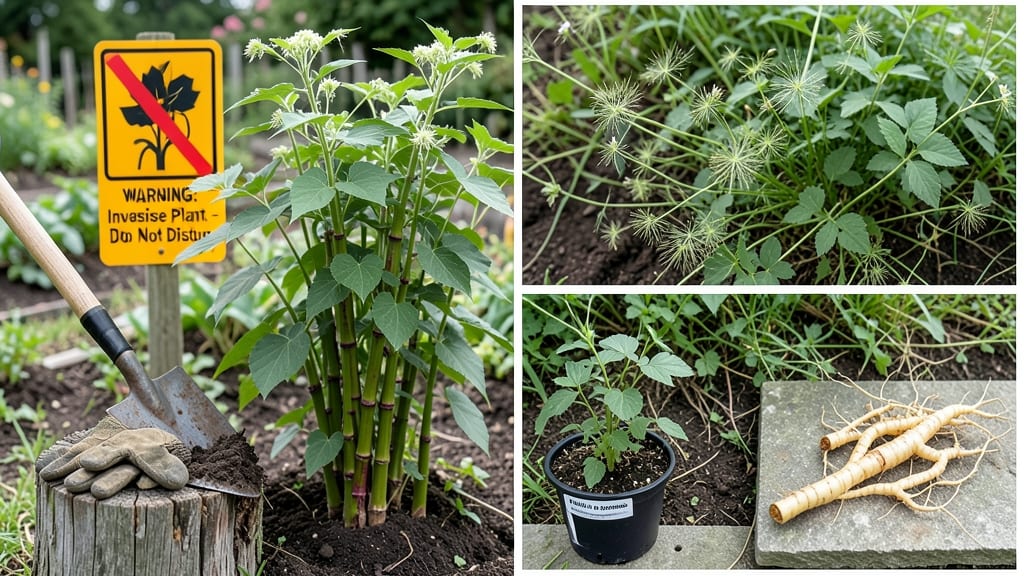
Identifying knotweed invasive species early is crucial because Japanese knotweed (Fallopia japonica) and giant knotweed (Reynoutria sachalinensis) can destroy landscapes and property values. Japanese knotweed displays distinctive heart-shaped leaves with pointed tips, while giant knotweed has broader, shield-like foliage with a noticeable waxy coating. Their rapid spread makes quick action essential to prevent permanent damage.
These aggressive plants can shoot up 6-10 feet tall in a single season, choking out native vegetation and weakening foundations. 🌱 I’ve seen firsthand how a small patch can explode into a full-blown infestation within months if left unchecked.
The key to stopping them lies in recognizing those leaf shapes early—Japanese knotweed’s pointed tips and zigzag stems set it apart from giant knotweed’s broader, more rounded leaves.
Both species produce bamboo-like canes, but the leaf texture gives them away: giant knotweed’s foliage feels almost plastic-like to the touch, while Japanese knotweed’s leaves are smoother and more delicate.
Once you spot them, act fast. Mechanical removal works best in early spring before new shoots emerge, but you’ll need to dig deep—roots can extend 3-6 feet underground. For stubborn patches, targeted herbicides like glyphosate are often necessary, though they require careful application to avoid spreading the problem.
💡 In This Article
- Key Differences Between Japanese and Giant Knotweed Leaves
- How to Prevent Knotweed Spread in Gardens and Landscapes
Key differences between Japanese and giant knotweed leaves
The most reliable way to tell these species apart starts with leaf shape and arrangement. Japanese knotweed (Fallopia japonica) grows in alternate, arrowhead-shaped leaves with pointed lobes, resembling a heart with two sharp tips.
These leaves typically measure 3-8 inches long and 1-5 inches wide, with jagged edges that create a serrated appearance. The stems grow in a distinctive zigzag pattern, which helps distinguish it from other plants. 🔥
Giant knotweed (Reynoutria sachalinensis), on the other hand, has broader, shield-like leaves with a more rounded shape and a noticeable waxy coating that gives them a slightly glossy, almost plastic-like texture.
These leaves can reach 12-18 inches long and 6-12 inches wide, making them significantly larger than Japanese knotweed's foliage. The stems grow straight and sturdy, supporting the plant's towering height of 6-10 feet, while Japanese knotweed typically maxes out around 5-8 feet.
The vein structure also differs: Japanese knotweed leaves have prominent veins that create visible ridges, while giant knotweed's veins are more subtle and spread evenly across the leaf surface.
Another key detail is the leaf attachment—Japanese knotweed's leaves attach to stems with a short stalk, while giant knotweed's leaves often appear sessile (directly attached) to the stem. These differences become especially noticeable when examining plants side-by-side during their active growing season (spring through fall).
Seasonal variations further complicate identification. In early spring, both species emerge from rhizomes (underground stems) as small shoots, making them nearly indistinguishable. However, by late spring, the leaf differences become more pronounced.
Japanese knotweed develops its characteristic reddish-purple stems and green leaves with red veins, while giant knotweed maintains green stems with broader, more uniform leaf coloring. 🌿
One advanced identification technique involves examining the flower clusters. Japanese knotweed produces small white flowers in loose, branching clusters, while giant knotweed develops denser, cream-colored flower spikes that appear later in the season.
These floral differences can be crucial when dealing with mature plants where leaf characteristics might be obscured by dense foliage.
For gardeners and landowners, understanding these distinctions is critical because misidentification can lead to ineffective control measures. Japanese knotweed's rapid rhizome spread can penetrate concrete and asphalt, while giant knotweed's aggressive above-ground growth can smother entire garden beds.
Both species produce bamboo-like canes that can regrow from tiny root fragments, making proper identification the first step toward effective management.