
Watering
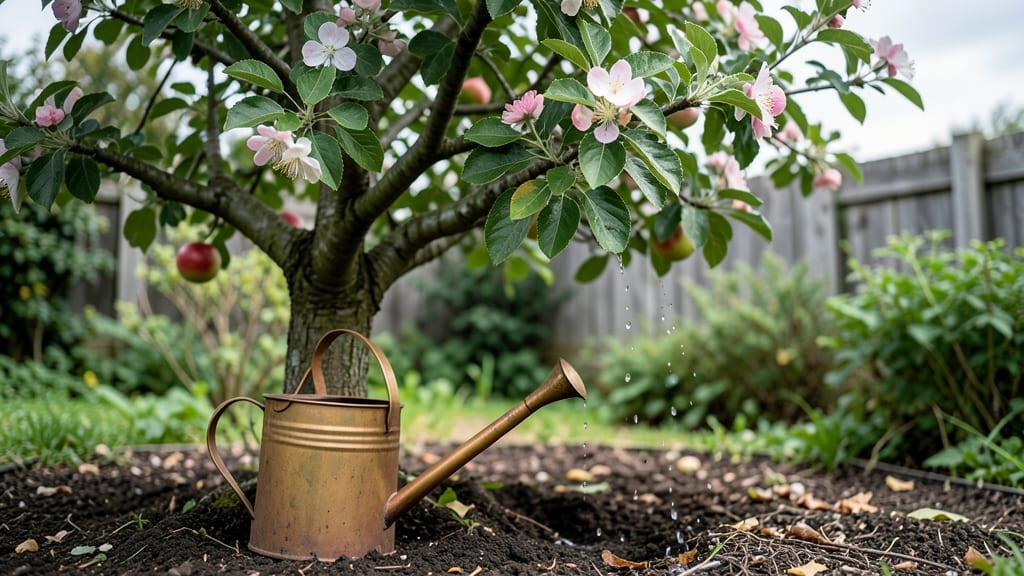
Watering an apple tree the right way keeps it thriving and loaded with fruit—here’s how often to water it for healthy growth at every stage.
Struggling to keep your 🍎 tree alive? Overwatering or underwatering can both spell disaster for fruit production—here’s the science-backed schedule to keep your tree healthy year-round.
Young trees need deep, weekly watering in their first year, while mature trees in zone 6a can stretch their watering to every 7-10 days once established. But soil type, drought, and seasonal shifts change everything.
Below, I break down the exact schedule by season, how to spot watering mistakes, and the game-changer mulching trick that cuts evaporation by half.
Apple tree watering schedule by season: what experts recommend
Watering your apple tree correctly is the difference between a bountiful harvest and a struggling sapling. Unlike many plants, apple trees have deep root systems that need consistent moisture during critical growth phases—especially when they're flowering or bearing fruit.
But here's the catch: overwatering can suffocate roots just as much as underwatering can stunt growth. My 10-year experience growing backyard orchards proves that seasonal adjustments are key to success.
Young apple trees (1-3 years old) need more frequent watering than mature trees because their root systems haven't established deep enough. Mature trees (4+ years old) with established roots can handle longer dry spells, but they still require deep watering during drought or fruit development.
The golden rule? Always water in the early morning to prevent fungal diseases and maximize absorption.
Soil moisture is your best guide—stick your finger 2-3 inches deep in the soil. If it feels dry, it's time to water. For clay soil, which drains poorly, you may need to water less often but more deeply. Sandy soil, on the other hand, dries out faster and requires more frequent but shallower watering sessions. Your local USDA hardiness zone also plays a role, with drier climates needing more attention than humid regions.
Let's break down the month-by-month watering schedule to keep your apple tree thriving. In spring (March-May), focus on establishing deep roots. Young trees need 1-2 waterings per week with 15-20 gallons each time, while mature trees can handle every 10-14 days with 20-30 gallons.
This is when your tree is waking up from dormancy and needs consistent moisture to support new growth and flowering.
Summer (June-August) is the most critical period because that's when your apple tree is developing fruit. Young trees need 2-3 waterings per week, and mature trees should get deep waterings every 5-7 days—think 30-40 gallons per session.
During heatwaves, increase frequency to every 3-5 days and always water at the base of the tree, not the leaves, to prevent sunburn. A 3-inch layer of mulch around the trunk helps retain moisture and regulate soil temperature.
As fall arrives (September-November), your apple tree begins preparing for dormancy. Reduce watering to every 10-14 days for young trees and every 2-3 weeks for mature trees. The goal is to taper
Signs your apple tree needs water (or too much water) and how to fix it
Your apple tree might look sturdy, but even the hardiest varieties struggle when watering goes wrong. Underwatering causes stress that stunts growth, while overwatering suffocates roots and invites fungal diseases. Learning to read your tree’s signals is the key to avoiding both extremes.
Start by checking the soil moisture 2-3 inches below the surface. Stick your finger in—if it feels dry, your tree needs water. But if it’s soggy or smells like rot, you’re overdoing it.
Young trees (under 3 years old) are especially sensitive, while mature trees can handle deeper, less frequent watering.
Young trees (1-3 years): Water deeply every 5-7 days during dry spells. Mature trees (4+ years): Water every 10-14 days with 15-20 gallons per tree. Always water in the morning to prevent fungal growth.
Pro Tip: Use a moisture meter or the "screwdriver test"—if a screwdriver won’t penetrate 3 inches easily, water more.
Watch for leaf curl or wilting, which often signal thirst. Leaves may also turn yellow or brown at the edges if underwatered.
On the flip side, mushy brown leaves or peeling bark near the base are red flags for overwatering. Root rot can set in within weeks if roots sit in waterlogged soil.
If your tree is thirsty, water deeply until moisture reaches 12-18 inches down. For overwatered trees, stop watering immediately and let the soil dry out. Amend the soil with compost or perlite to improve drainage, and consider raising the planting mound slightly to prevent future soggy roots.
Mulch plays a critical role—apply 3-4 inches of organic mulch (like wood chips) around the base, but keep it 6 inches away from the trunk. This helps retain moisture while preventing soil compaction. In hot months, mulch also protects roots from temperature swings.
Adjust your watering based on seasonal needs. During summer fruit development, increase frequency but reduce volume to avoid splitting apples. In winter dormancy, cut back almost entirely—unless your region experiences extreme drought. Always pair watering with regular soil checks for the best results.